
Heat Pump Health: Why That Dust Isn't Just Ugly — It's Costing You! (Auckland Edition)

The Auckland Heat Pump Services Team • March 25, 2026

Share this article

Why Is My Heat Pump So Dusty? The Hidden Impact on Your Auckland Home

Key Takeaways

  • Visible dust on your heat pump covers and filters represents only a small fraction of the debris trapped deep inside the unit.
  • Dirty coils and fan barrels can increase your energy consumption by up to 35 percent, leading to significantly higher monthly power bills.
  • Auckland’s humid climate encourages the growth of mould and biofilm on damp internal components, which can compromise your indoor air quality.
  • Professional servicing restores airflow and heat transfer to near-new levels, extending the lifespan of your system to 15 or 20 years.

We often hear from homeowners who are frustrated by a heat pump that looks dusty just days after they have wiped it down. Whether you are running a busy cafe in Ponsonby or managing a family home in Papakura, that fine layer of grey fluff on the louvres is a signal that something more significant is happening inside the machine. While a quick wipe of the exterior makes the room look better, the real performance and hygiene issues live where you cannot see them.

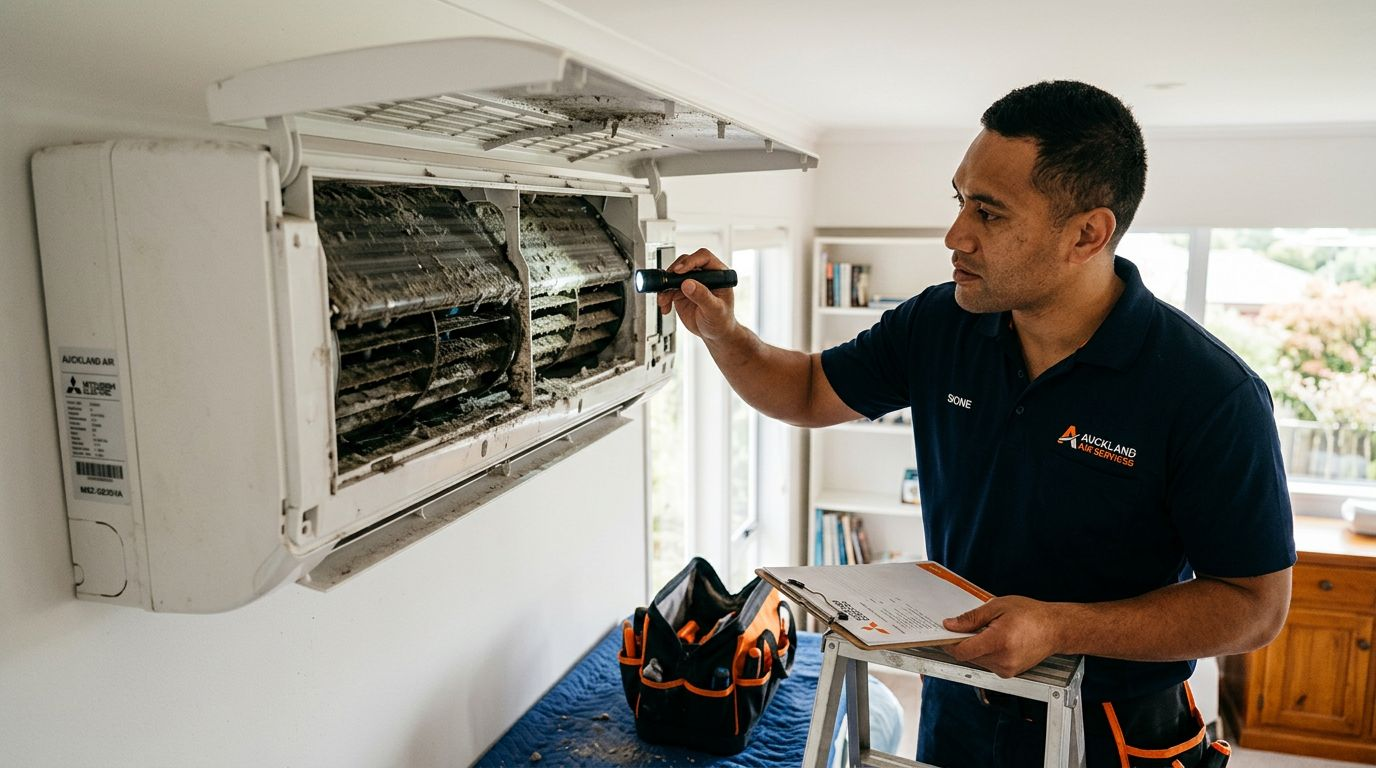
The dust you see on the surface is the tip of the iceberg. Behind the covers, your heat pump contains a complex network of aluminium fins and a cylindrical fan barrel that works tirelessly to move air. Over time, these components become magnets for dust, pet hair, and cooking aerosols. When these particles meet the moisture naturally produced during the cooling and dehumidifying process, they create a stubborn, sticky grime that standard DIY cleaning cannot reach.

The Invisible Build-up: Coils and Fan Barrels

Your heat pump operates by pulling large volumes of air through a series of cold or hot coils. In a typical Auckland home, this air carries everything from skin flakes to microscopic pollen. While the mesh filters catch the larger debris, the finest particles pass through and settle on the wet surfaces of the evaporator coil. In our humid climate, these coils stay damp for long periods, providing the perfect environment for dust to bond with moisture.

This process creates a layer of "fouling" that acts as insulation. Instead of the air directly hitting the metal fins to change temperature, it has to fight through a blanket of dirt. Research indicates that typical evaporator coils can accumulate enough debris to double the pressure drop within seven to eleven years, according to a study by the Lawrence Berkeley National Laboratory. This restriction forces the fan to work harder and the compressor to run longer to achieve the same temperature.

How Dirty Coils Impact Your Power Bill

A dusty heat pump is an inefficient heat pump. When the internal components are coated in grime, the system loses its ability to transfer heat effectively. This inefficiency shows up directly on your electricity statement. Data shows that dust and dirt trapped in filters and coils can increase power consumption by 10 to 35 percent.

For a standard household, this translates to real money. An annual professional clean and service can save up to $250 a year on energy bills by restoring the system to its peak operating state. You can read more about the financial benefits in our guide to the heat pump health check. Beyond the immediate savings, keeping the coils clean prevents the compressor from overheating, which is a common cause of expensive, premature mechanical failure.

The Auckland Factor: Mould and Biofilm

Auckland’s weather plays a major role in how quickly your heat pump gets "dirty." Our high humidity means that the indoor unit often acts as a dehumidifier. The moisture collected from the air sits in a drip tray before flowing out through a drain pipe. When dust mixes with this standing water, it forms a biofilm, a slimy matrix of microorganisms that can harbour bacteria and mould.

If you notice a musty smell, often described as a "dirty sock" odour, when you first turn the unit on, you are likely smelling this biological growth. This is particularly common in homes with pets or high foot traffic. These spores are then circulated back into your living space, which can trigger allergies or respiratory issues. A professional service involves disinfecting these hidden areas with specialised, eco-friendly cleaners that neutralise mould at the source.

The Difference Between DIY and Professional Cleaning

We always encourage homeowners to stay on top of basic maintenance. Vacuuming your filters every two to four weeks is the best way to keep the airflow consistent and protect the internal components from the heaviest dust loads. We have put together a DIY filter cleaning guide to help you manage this safely at home.

However, DIY maintenance has its limits. A professional clean is a deep-tissue massage for your heat pump. Our technicians, who are registered electricians, go far beyond the filters. We remove the entire outer casing to access the evaporator coil and the fan barrel. Using low-pressure wash systems and specific coil cleaners, we flush out the grime that has been baked onto the metal over months of use. This process also includes clearing the drainage lines to prevent water leaks and checking the electrical connections for safety.

Signs Your Heat Pump Needs a Professional Clean

You can usually tell when your system is struggling by paying attention to a few key warning signs. If you find yourself turning the temperature up or down further than usual to get comfortable, the coils are likely fouled. Similarly, if the air coming out of the louvres feels weak even on the highest fan setting, the fan barrel is probably weighed down by dust.

Other common triggers include:

  • Visible black spots or grey fluff on the fan blades behind the louvres.
  • A persistent musty or damp smell when the unit is running.
  • Unusual noises, such as a slight "wobble" sound from the fan.
  • Water dripping from the bottom of the indoor unit onto your floor.

The Australian Government HVAC factsheet notes that a dirty condenser coil can increase compressor energy consumption by 30 percent. This highlights why professional attention is a necessity rather than a luxury for maintaining a healthy, efficient home.

Restoring Your Comfort

At Auckland Heatpump Services, we have spent over 15 years helping locals get the most out of their climate control systems. We believe in straight-up advice: a clean heat pump lasts longer, runs quieter, and costs less to operate. By investing in a professional service, you are not just getting rid of the dust you can see, you are protecting the air your family breathes and the investment you have made in your home.

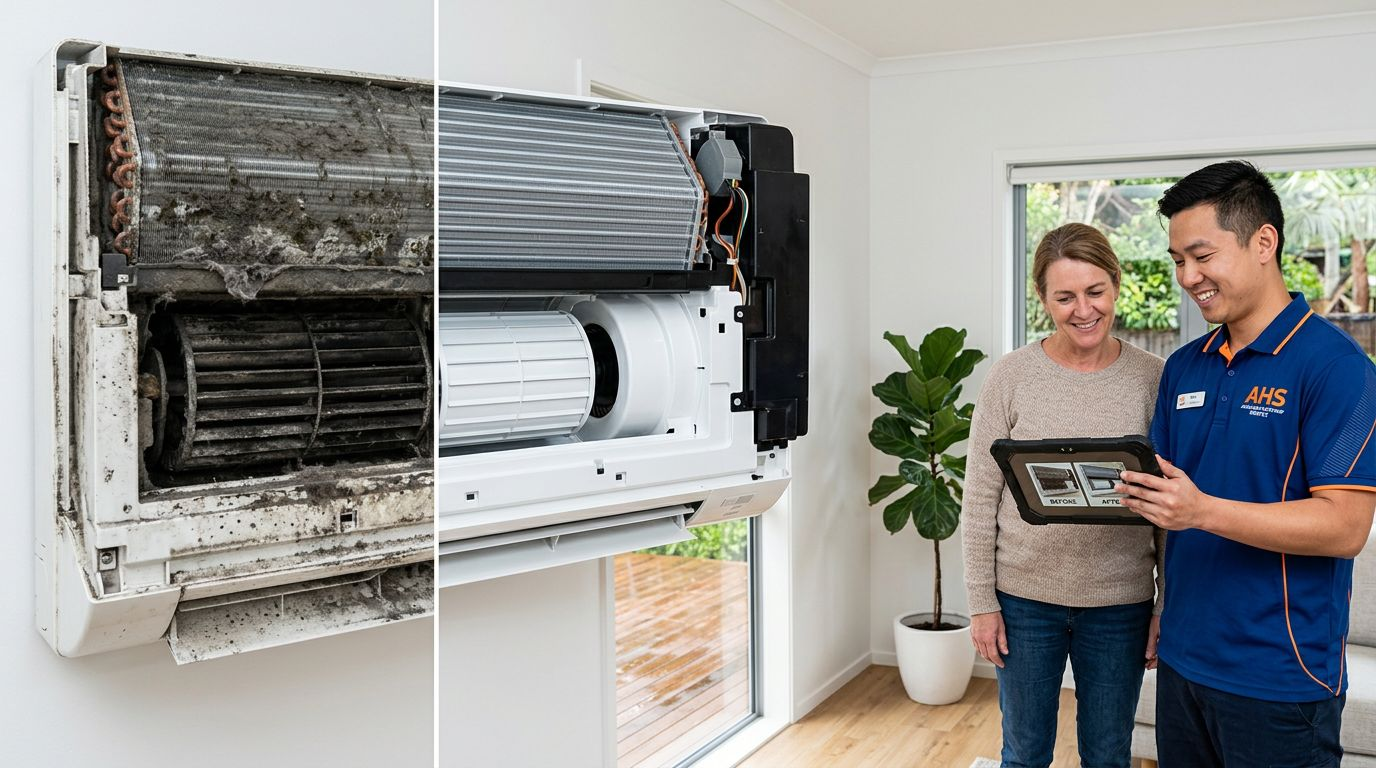
If your unit is looking dusty or your power bills are climbing, it is time to look deeper. You can book a comprehensive heat pump service with our team to ensure your system is ready for the season ahead. We provide before and after photos of the coils and fan barrel so you can see exactly what was hiding inside and enjoy the peace of mind that comes with a truly clean machine.

Recent Posts

By The Auckland Heat Pump Services Team March 23, 2026
Confused by blinking lights on your Daikin heat pump? Our Auckland experts decode U4, E7, and A6 codes to help you save on energy bills and restore home comfort.
By The Auckland Heat Pump Services Team March 7, 2026
Learn how to service your heat pump with our simple step-by-step filter cleaning guide. Reduce power bills by 35% and improve air quality in your Auckland home.
By The Auckland Heat Pump Services Team March 3, 2026
Is your heat pump blowing cold air? Follow our expert troubleshooting guide for Auckland homeowners to fix common issues and improve heating efficiency.
By The Auckland Heat Pump Services Team February 25, 2026
Discover why Fujitsu heat pumps are a top choice for Auckland homes. Learn about energy efficiency, ZERL ratings, costs, and the benefits of professional installation.
By The Auckland Heat Pump Services Team February 24, 2026
Keep your Auckland home comfortable and your power bills low with our comprehensive heat pump maintenance checklist. Learn what to do yourself and when to call the pros.
By The Auckland Heat Pump Services Team February 20, 2026
Learn which heat pump maintenance tasks you can handle yourself in Auckland and why professional servicing is essential for efficiency and warranty protection.
By The Auckland Heat Pump Services Team February 15, 2026
Learn how seasonal considerations for heat pump use can save you up to $250 a year. Expert advice for Auckland homeowners on preparing for winter and summer.
By The Auckland Heat Pump Services Team February 13, 2026
Discover how modern heat pumps reduce emissions in Auckland. Learn about NZ's renewable grid, R32 refrigerants, and why moving heat is better for the planet.
By The Auckland Heat Pump Services Team January 31, 2026
Discover the actual running costs of heat pumps in Auckland. Learn how to calculate hourly costs, read energy labels, and save on power bills with expert tips.
By The Auckland Heat Pump Services Team January 28, 2026
Discover how to choose the best small heat pump for your Auckland apartment or unit. Learn about right-sizing, quiet operation, and efficient compact models.
Show More